May 18, 2026 | Michael Jestadt
Ductless Mini-split vs Central AC
When you have decided to keep your home cool and comfortable, you have two major options. They are ductless mini-split and central AC. Both of them come with their own set of pros and cons. Choosing the best one depends on various factors like home layout, budget, and your personal requirements. In this article, we will deep dive into the topic of ductless mini-split vs central AC so that you can know the differences and make the right choice for your home. Let’s get started!
What is a Ductless Mini-split System?
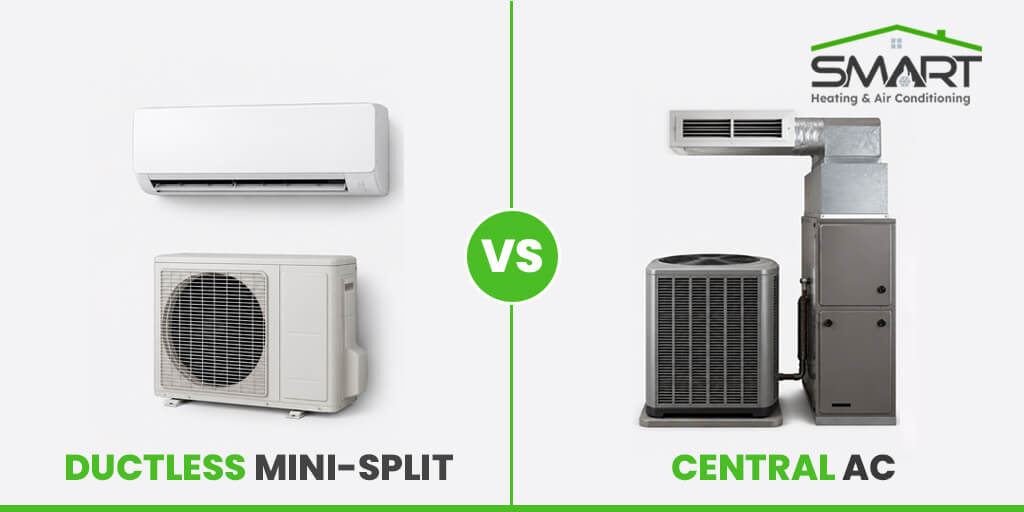
A ductless mini-spli system has two major components, which are an outdoor compressor and indoor units that are installed in different rooms. The indoor units are connected by the outdoor compressor through refrigerant lines. Apart from a traditional air conditioning system, a ductless mini-split doesn’t need any ducts to circulate the air. So most homeowners find it a perfect choice for spaces like garages, sunrooms, or room additions that don’t have any ductwork.
Advantages of a Ductless Mini-split
- Energy Efficiency: Ductless mini-split systems are more energy efficient than ducted systems. You can use them whenever the space is occupied.
- Minimally Invasive Installation: As the system comes with no ducts, it can be installed easily without any major construction work. You need to drill a small hole to pass wiring and refrigerant pipes from the outdoor unit to the indoor unit.
- Flexible Installation: The refrigerant lines are long, compact indoor and outdoor units, no ductwork needed, and can be installed in any place.
- Targeted Comfort: You can heat or cool a specific room in your home according to your requirements. You can also use it as a support for your central AC system, which is struggling with temperature control. You can get a single-zone and multi-zone split in this system, and you can choose them according to your requirements.
Disadvantages of a Ductless Mini-split
- Initial Upfront Cost: If you are looking to cool your entire home, installing a ductless mini-split can be a more expensive choice than a central AC.
- Visibility of the Indoor Units: The indoor units are usually wall, ceiling, or floor-mounted and can be easily noticed in the room.
- Indoor Air Quality: Compared to central AC, ductless mini-splits have less control over the indoor air quality.
What is a Central Air Conditioning System?
A central AC cools or heats the air in one central location and circulates it through the entire home by using ducts. It includes an outdoor unit connected with an indoor evaporator coil. The cool air moves through the ducts and cools your home evenly.
Advantages of Central AC
- Less Intrusive Installation: If your home already has ductwork, you don’t need to worry about the ductwork, which thereby saves your time, money, and labor. Also, you need one unit to cool your entire home rather than installing one in each room.
- Convenience: From the operation to the thermostat, everything is centralized. You can have control over your home’s temperature with a single thermostat.
- Indoor Air Quality: When compared to a ductless mini-split system, a central air conditioning system is more effective in maintaining indoor air quality.
- Lower Systems Cost: The cost will be lower for a central air conditioner installation than for installing a ductless mini-split in each room.
Disadvantages of Central AC
- Cost of Ductwork Installation: If your home doesn’t have ductwork, you need to bear the expense of ductwork installation.
- Energy Efficiency: While higher efficiency central AC systems can reach 26 SEER, some ductless systems can reach 35 SEER.
How to Choose: Mini-split vs. Central Air
While choosing between a ductless mini-split and a central AC, it depends on your home layout and your specific requirements. The choice depends on two major factors: Areas to be cooled and whether the home has ductwork or not. If you need specific areas to be cooled without major ductwork and all, you can opt for a ductless mini-split. Whereas, if you are trying to cool your entire home, you can choose a central air conditioning system.
Factors to Consider Before Buying a Ductless Mini-Split or Central AC
- Home Size and Layout: Central AC is an affordable and better option for larger homes. Also, mini-split systems are the best option if your home is small or you need specific areas where separate temperature control is needed.
- Existing Ductwork: If your home has ducts, central air is typically the more affordable installation. For homes without ducts, like historic properties or new additions, a mini-split is the ideal choice.
- Energy Efficiency: Ductless mini-splits are more energy efficient as they cool limited spaces. Whereas, central AC consumes more energy as they need to cool more spaces. If there is any leakage in the ductwork, the consumption can be even more.
- Installation and Aesthetics: Central AC is simple, and only the AC vents are visible outside. Whereas ductless mini-split systems are mounted on walls or ceilings, the entire indoor unit is visible, which can affect the room’s appearance.
- Upfront Cost vs Long-term Value: If there are existing ducts in your home, the central AC can be an affordable option. But, ductless mini-split systems offer you better ROI while reducing energy consumption.
Final Thoughts
Both a ductless mini-split system and a central AC are good options. But you need to consider some factors like cost, home layout, preferences, and choose the right one. If you are still unsure of what to choose for your home, we can help! At Smart Heating and Air Conditioning, we have experienced technicians who can assess your home and suggest the best air conditioning system for your home. We also deal with HVAC services, ductwork, zoning, and new equipment in Contra Costa and Alameda County, CA. Contact us today and schedule your appointment.