Sep 17, 2026 | Michael Jestadt
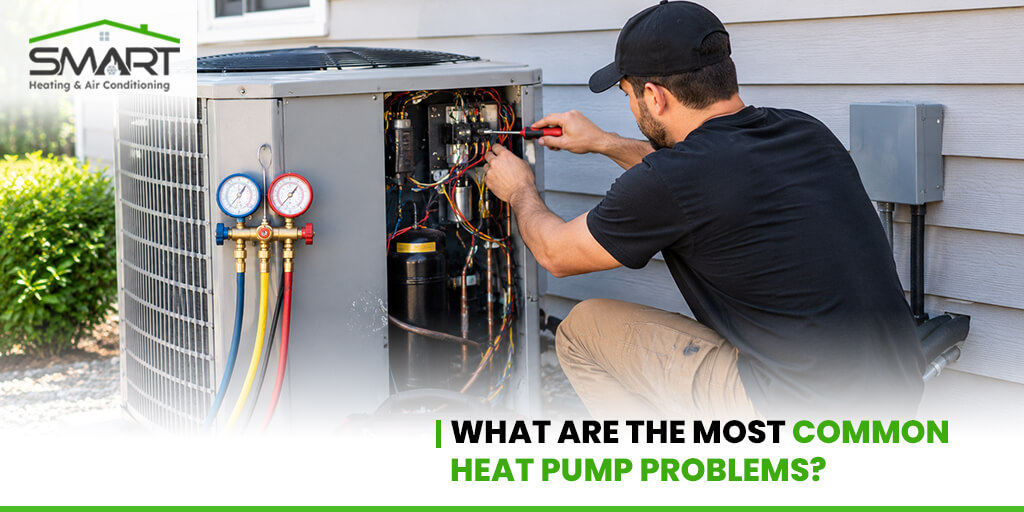
What Are the Most Common Heat Pump Problems?
Heat pumps are a great way to heat and cool your home throughout the year. Apart from using traditional heating and cooling systems, heat pumps provide both heating and air conditioning with the same equipment. They do not create heat from full combustion; rather, they move heat from one place to another. Though heat pumps are efficient, problems arise over time. Some are caused by normal wear and tear, while others are caused by poor maintenance, electrical problems, refrigerant leaks, or damaged components. In this article, we will explain the most common heat pump problems, their possible causes, and when to call a professional HVAC technician.
Common Heat Pump Problems
1. Heat Pump is Not Heating or Cooling
One of the most common heat pump problems is that the system runs but does not maintain the temperature. Common reasons can be a dirty air filter, which restricts airflow and makes it harder for the heat pump to circulate air. Another reason can be low refrigerant levels, which affect the ability to transfer heat. Sometimes the reversing valve might be damaged or not working properly, making the system struggle to provide the desired temperature.
Check your thermostat settings and ensure the system is in the correct mode. Also, check whether the air filter is blocked or needs replacement. If the problem persists, contact an HVAC professional to check for the issue.
2. Heat Pump Is Not Turning On
Sometimes, a heat pump may not turn on at all. You may notice that the indoor blower and outdoor unit remain quiet, or the thermostat does not activate the system. This problem can happen at any time.
If the power is interrupted, the system may not run. So, check the thermostat to see if it’s working and whether it has weak batteries. Also check your home’s electrical panel for a tripped breaker. If a breaker trips repeatedly, do not keep resetting it. Repeated electrical problems may indicate a serious issue that requires professional attention. A qualified HVAC technician can inspect the system and find out the reason.
3. Heat Pump is Blowing Cold Air in Heating Mode
A heat pump naturally moves heat from outside into your home during winter. However, if your home is not warming up, there might be an issue with the system. Heat pumps sometimes enter a defrost cycle during cold weather. So, during this process, the system changes itself to remove the ice built up on the outdoor coil. During defrost, the system may produce cooler air for a short time, which is completely normal.
But if the system continuously blows cold air, there ight be an issue which needs to be addressed by a professional.
4. Heat Pump is Not Cooling Properly
During summer, a heat pump works like an air conditioner by removing heat from your home and releasing it outdoors. If the heat pump is running for longer periods and doesn’t cool your home, there might be various underlying issues.
A dirty outdoor coil or a refrigerant leak can be possible reasons. This can make it harder for the heat pump to release heat and increase operating costs. Adding refrigerant will provide only a temporary solution, and it needs to be checked by an HVAC professional.
5. Heat Pump is Making Strange Noises
Heat pumps commonly make noises during their operation. But unusual noises can trigger a mechanical or technical issue. Common heat pump noises are:
- Banging – Caused by a loose or damaged mechanical component
- Grinding – Due to worn bearings, motor problems, or other mechanical issues.
- Hissing – Airflow, pressure changes or a refrigerant leak can be the reason.
- Clicking – Usually, clicking sounds are normal when the system starts or stops. Repeated clicking can indicate an electrical problem or a control problem.
- Buzzing – Comes from electrical components, loose parts, or motor problems.
- Rattling – Loose screws, panels, debris, or damaged components might be the reason.
Do not ignore or continue to operate the heat pump. Contact your HVAC professional for a complete heat pump tune-up.
6. Heat Pump Has Ice on the Outdoor Unit
There will be a small frost formation on the outdoor coil that is completely normal. But during the automatic defrost cycle, the frost will be removed. If it’s not happening, heavy ice buildup can eventually affect the system’s performance. When this happens, it will be difficult for the heat pump to absorb heat from the outside.
When ice is covering the outdoor coil, the heat pump may struggle to absorb heat from the outside air. Do not remove it with any sharp tools or pour hot water on it. Instead, turn off the system and call your HVAC expert to inspect it.
7. Short Cycling
Short cycling happens when a heat pump turns on and off repeatedly without completing a normal heating or cooling cycle. This can happen when the heat pump is oversized. Frequent short cycling can cause increased energy usage and add additional stress on the components. So, call your HVAC expert rather than simply adjusting the thermostat frequently.
8. Poor Airflow
Good airflow is important for proper heat pump operation. If air cannot move freely through the system, the heat pump may struggle to heat or cool your home. You may notice weak airflow from the vents; due to this, it takes longer than usual to maintain temperature. A clogged filter may be one of the reasons for this. Over time, dust and debris can build up and reduce the airflow. Sometimes, even duct leaks can also be an issue.
If it’s a blocked air filter, you can replace it yourself. But if it’s an issue in the ductwork, it needs professional inspection.
9. Leaking Water from the Heat Pump
Water around an indoor heat pump or air handler can be caused by a drainage problem. During cooling, the system removes moisture from indoor air in the form of condensation. This moisture will be sent outside through a drainage system.
If the drain is blocked, water can pile up and leak around the equipment. If you notice water near the indoor unit, turn off the system if necessary and arrange a professional inspection.
10. High Energy Bills
A sudden increase in energy bills may indicate that the system is not operating properly. Higher energy use does not always mean the heat pump is faulty. There might be many factors, like changes in outdoor temperatures, thermostat settings, home insulation, and electricity rates, that could be the reasons.
When a heat pump is in heating mode, it uses more electricity, especially if the backup heat runs longer than expected. Check your thermostat and air filters. Make sure doors and windows are properly sealed and that vents are not blocked. If the energy bills remain high, a professional heat pump inspection is required.
11. Faulty Reversing Valve
The reversing valve is important to change the direction of refrigerant flow. This helps the system to switch between heating and cooling. If the reversing valve is damaged or stuck, the heat pump will remain in either heat or cold or fail to maintain the required temperature. Mechanical damage, electrical issues or control system issues usually cause this. As it is one of the parts of the refrigerant system, it should be checked by a professional.
12. Irregular Maintenance
Like other HVAC systems, heat pumps have filters, coils, electrical components, fans, and moving parts that need attention. Regular maintenance is important to identify heat pump problems before they become expensive repairs. Without proper maintenance, dirt and wear can affect the system’s performance. You need to remember that regular maintenance will not make a system never break down; instead, it helps to identify potential issues.
How Smart Heating and Air Conditioning Can Help!
A heat pump problem can affect your home’s comfort, energy use, and indoor air quality. Whether your system is not heating properly, making unusual noises, or struggling to maintain the right temperature, identifying the cause is an important first step. At Smart Heating and Air Conditioning, we provide reliable heat pump services for homeowners in Contra Costa County, Alameda County, and surrounding East Bay communities. Our technicians can help inspect heat pump problems, identify possible causes, and explain available repair or replacement options. Contact us today for more details!