Jul 21, 2026 | Michael Jestadt
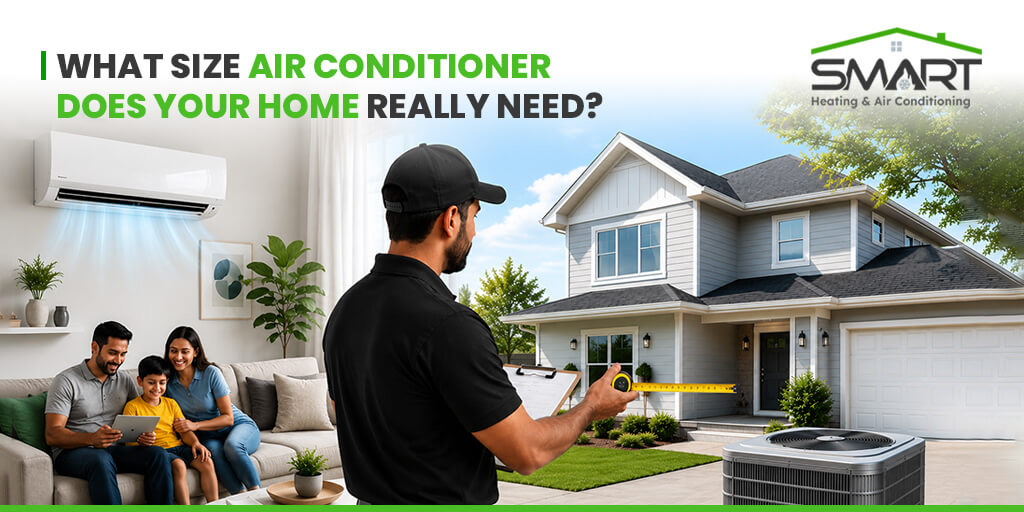
What Size Air Conditioner Does Your Home Really Need?
Air Conditioners have made our lives easier. They provide us with relief from the extreme heat. Due to the improvement in technology, modern ACs do more than cool your home. They reduce the chances of asthma attacks, prevent insects and parasites from entering the home, reduce the overheating issues of the appliances, and much more. So, to make all the things happen, it’s important to choose the right-sized air conditioner. The right size cools your home effectively and reduces your energy costs. Not only does it cool, but it also improves the air quality, performance, and longevity of the unit. In this article, we will look into the topic of what size air conditioner your home really needs in detail. Let’s get started!
Understanding Air Conditioner Sizes
Usually, air conditioners are measured in British Thermal Units (BTUs). This indicates the amount of cooling an AC can provide. Higher BTU means an AC is capable of cooling a larger area. The BTU is measured by considering the room size, which is measured in square feet. Understanding the square footage and BTU rating can help you choose the right air conditioner size for your home.
Why Choosing the Right AC Size is Important
The size of your Air Conditioner plays a key role in maintaining comfort and energy savings in your home. AC is sized in terms of tons, which shows the amount of heat an AC can remove in one hour. One ton is equal to 12,000 BTUs (British Thermal Units) per hour. So, deciding your AC size based on BTUs will cool your home properly while using the energy efficiently.
The following are the benefits that a correctly sized air conditioner offers:
- Lower monthly energy bills
- Improved indoor comfort
- Better humidity control
- Fewer repairs and maintenance issues
- Consistent and even cooling
- Better longevity
Factors Affecting the Size of Your Air Conditioner
While choosing the right air conditioner, you need to consider various factors. These help you to know the right size for efficient and comfortable performances.
- Size of the Room: The size of the room or the area that needs to be cooled plays a major role in determining the right AC size. Larger spaces need AC units with higher BTUs, whereas smaller rooms need ACs with lower BTUs. If the unit is too small, it can struggle to cool the room. If the unit is too big, it can frequently turn on and off, which results in higher energy usage and less comfort.
- Number of Occupants: The number of occupants also affects the air conditioner needs. If you have more occupants in the room, there will be more heat generated, which increases the amount of cooling. Rooms that frequently have gatherings or hosting need an AC unit that is larger than normal to maintain a comfortable temperature.
- Climate Zone: The location and the climate in which your home is located also play a significant role in AC sizing. Homes in hotter climates need ACs with higher BTU capacity to withstand the challenging heat. Whereas, in mild or cooler climates, smaller units are enough to provide you with the required cooling. Improve efficiency and comfort by considering climate as an important factor.
- Quality of the Insulation: There is a significant difference you can observe between an insulated and a non-insulated home. A properly insulated home cools faster and stays cool for longer periods. This helps in making your AC work more effectively. Also, good insulation maintains the cool air inside and prevents the heat from entering the home. This reduces the amount of cooling required. This shows that a well-insulated home requires a smaller AC unit compared to a poorly or non-insulated home.
- Windows and Doors: The type and condition of your windows and doors can impact the AC requirements. Improperly sealed and inefficient doors and windows allow warm air to enter and cool air to escape, which makes your AC work harder. In these cases, you might need a large AC unit to maintain comfort in your home.
- Room direction and Sunlight: The direction of the room can impact your air conditioning requirements. Rooms that get access to direct sunlight usually need larger AC units for optimal comfort. Whereas, rooms with shade need smaller units and need less cooling power.
- Ceiling Height: Higher ceilings mean higher volume. Rooms with higher ceilings need to cool more air, which can affect AC performance. If your home’s ceiling height is greater than 8- 9 feet, you need more cooling capacity to maintain a comfortable temperature. In such cases, a larger unit will be required to cool the space effectively.
- Heat-Generating Appliances: Every house has heat-generating appliances like ovens, dryers, and computers that can affect cooling.
Right Size AC for your Home
Most of the online AC calculators suggest you get an AC depending on the square footage. These online calculators give you a rough estimation without considering the factors that were discussed above.

These are just general estimates. But you may need a professional HVAC inspection that considers all the above factors and recommends an air conditioner.
The Right AC Size Makes All the Difference
It is important to choose the right-sized air conditioner to maintain comfort, efficiency, and reliability. If you choose a unit that is too large, it can create energy wastage and humidity issues. Whereas, a too-small unit can take so long or struggle to keep your home cool. So, it’s better to choose Smart Heating and Air Conditioning for professional AC Services, calculation, installation, and replacement to help your system run effectively all year long. Contact us and schedule your AC consultation today!